Showing posts with label slum urbanism. Show all posts

Monday, January 14

Video from inside Kowloon Walled City

A quick post today following up on my previous effort to make sense of Kowloon Walled City. The first video surfaced on YouTube about 6 months ago. It was apparently filmed in 1990, what would have been 2 years before the city's demolition. This is truly amazing footage, I don't think anything else like it exists. You'll find a quick guide below the video.


0.00 - 0.50 | Kowloon Walled City at a block or two away
0.50 - 6.04 | Street life on the shell of the city
6.04 - 7:49 | Cutting a straight path beneath the city
7.49 - 9.04 | Re-emergence and more from the street

The next clip comes, surprisingly enough, from the Jean-Claude Van Damme fighter flick Bloodsport (1988). It's a 2 minute 20 second clip, of which the last 1 minute 40 seconds are are shot on location within the Walled City. It's kind of an airbrushed version of the clip above.


If anybody has any other resources on Kowloon Walled City that I haven't previously covered on BLYGAD before, do share!

Related
Friday Photography | Kowloon Walled City

Updates
Kowloon City is featured in Ron Fricke's Baraka (1992), see stills here. Thanks Fred!

Saturday, September 29

Friday Photography | Kowloon Walled City


Kowloon Walled City in 1915

We "Go East" in tonight's episode of Friday Photography. I wanted to follow up on a previous post about density in which I mentioned the Kowloon Walled City because it really is a fascinating story. I first learned about the city in reading William Gibson's Idoru, and later learned that he took further inspiration from the city for his amazingly realized anarchic sqautter city built into the Golden Gate Bridge Oakland Bay Bridge in his novel Virtual Light. As a real life local, the city has shown up up in various movies, even a Jackie Chan flick (1993's Crime Story). The Walled City even inspired the virtual settings for the video game Shenmue 2. An abbreviated & slightly annotated Wikipedia entry will weave us a short story about the amazing but now demolished Walled City:

The history of the Walled City (known as Kowloon then) can be traced back to the Song Dynasty, where it served as a watchpost defending the area against pirates and managing the production of salt. The Convention for the Extension of Hong Kong Territory of 1898 which handed parts of Hong Kong to Britain for 99 years excluded the Walled City [which at this point was located in the heart of Honk Kong proper], with a population of roughly 700.

[Throughout the next 50 years] the Walled City remained a curiosity - a tourist attraction where British colonials could have a taste of the old China - [that is] until 1940, when during its WWII occupation of Hong Kong, Japan evicted people from the Walled City, and then demolished much of it - including the wall.


After Japan's surrender, squatters [mostly newcomers] began to occupy the Walled City, resisting several attempts by Britain in 1948 to drive them out. With no wall to protect it, the Walled City became a haven for crooks and drug addicts, as the Hong Kong Police had no right to enter the City. Mainland China refused to take care of it. The foundation of the People's Republic of China in 1949 added thousands of refugees to the population.
This is my favorite paragraph. By this time it is the late 1970's and 1980's:

Square buildings folded up into one another as thousands of modifications were made, virtually none by architects or engineers, until hundreds of square meters were simply a kind of patchwork monolith. Labyrinthine corridors ran through the monolith, some of those being former streets (at the ground level, and often clogged up with trash), and some of those running through upper floors, practically between buildings. The streets were illuminated by fluorescent lights, as sunlight was rare except for the rooftops. The only rules of construction were twofold: electricity had to be provided to avoid fire, and the buildings could be no more than about fourteen stories high, because of the nearby airport. A mere eight municipal pipes somehow provided water to the entire structure (although more could have come from wells).
... the story continues:

Over time, both the British and the Chinese governments found the massive, anarchic city to be increasingly intolerable - despite the low reported crime rate. The quality of life in the city, sanitary conditions in particular, was far behind the rest of Hong Kong. After the Joint Declaration in 1984, the Peoples Republic of China agreed with British authorities to demolish the City and resettle its inhabitants. The mutual decision to tear down the walled city was made in 1987. At that time, it had 50,000 inhabitants on 0.026 km², and therefore a very high population density of 1,900,000 / km². At its height, it was one of the most densely populated urban areas on Earth.

Evacuations started in 1991 and were completed in 1992. The 1993 movie Crime Story starring Jackie Chan was partly made in the deserted Walled City, and includes real scenes of building explosions. Kowloon Walled City was destroyed in the same year. Also, as the Walled City was beginning to be torn down, a group of Japanese explorers took about a week to tour the empty walled city, making a sort of map and a cross section of the city.
That last part is fascinating. Whoever that group was, I really hope they published their research. If anybody has any information on it, or on the Kowloon Walled city in general, get in touch! Until then, I'll be keeping my eyes out for it...

OK! Enough chit chat, on with the pictures (all of which were found with a simple Google search):


Kowloon Walled City in 1973


City Of Darkness: Life in Kowloon City seems to be the definitive book documenting the city and what it was like to live there with beautiful full color photographs - this has been on my wish list for years. The only other online resource worth mentioning, besides the Wiki entry above, is this page from Twenty4 - there are some great photographs (presumbly taken from City of Darkness) there.

Happy Friday!

Saturday, September 22

Talk about mixed use

This is right up there with the Kowloon Walled City in terms of jaw dropping examples of shear density. I have no idea where this video was taken, but it's incredible. File under further evidence of ingenuity in the face of massive over population.


Skip to the end of this one for some beautiful shots from the side of train.

Sunday, January 21

Umoja: American Shantytown

It's resident's call it Umoja, the Swahili word for "unity" / the city of Miami calls it an illegal eyesore. Brainchild of activist Max Rameau, Umoja is part protest and part experiment. It's existence is a response to the growing housing crisis in Miami. A recent New York Times article reports that the Miami-Dade County planning department estimates Miami will need 294,200 new housing units by 2025, 42 percent of them for 'very low- or low-income households.

The shantytown has successfully fought for the right to exist using a 1998 federal district court ruling that says Miami can not criminalize homeless people for conducting “life-sustaining acts” including eating, sleeping, lighting a fire and building temporary structures on public land if local shelters were filled. Max keeps a blog documenting the project called Take Back the Land.


The small plot of public land is located in Liberty City, a neighborhood of Miami. The video below shows a makeshift city made up of about 16 structures. About 40 formerly homeless people call this place home. At Umoja they are off the streets; sleeping under a roof, cooking and eating with their neighbors, and taking care of each other when sick.


It seems the city has conceded for now:

The city commissioner who represents the area, Michelle Spence-Jones, had tried to shut the settlement down with an ordinance to require a permit for gatherings on public land. But after several visits to Umoja, she withdrew the ordinance and instead promised to arrange for trash pickup at the site three times a week.

Ms. Spence-Jones stopped short, however, at the group’s request for a mailbox. “That sends a whole other message,” she said. New York Times

It will be interesting to see how this develops. If successful, Umoja could prove to be a useful model for the homeless in other cities across the US.

If interested in doing more, you could watch more Umoja videos and then show support by signing Umoja's online petition.

Tuesday, December 19

Cities of the Poor


I caught the tail-end of this great program on PRI's The World earlier this afternoon. Cities of the Poor is a four part series taking an in-depth look at the circumstances that created the global slum phenomenon and what can be done to help improve life in these new informal mega-cities.


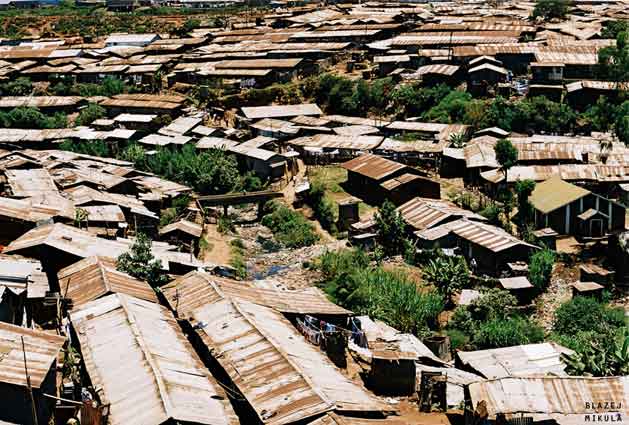
Today's installment by Sheri Fink focused on what life is like in one of Kenya's largest slums: Kibera (possibly the largest slum in Africa), it is the first of four installments. A complete transcript and photos by Fink are included. I believe you can catch the remaining three installments Tuesday, Wednesday, and Thursday on PRI's The World.

Tuesday, November 21

Reality Tourism

Continuing our series of tourism themed posts (here and here), Sandra from AFH San Diego drew my attention to a group called Reality Tours. Based out of Mumbai, India, Reality Tours offers 2 hour walking "Slum Tours" of the nearby city of Dharavi.


"In these small alleys, you will see why Dharavi is the heart of small scale industries in Mumbai (annual turnover is approximately US$ 665 million) and on the tour we show you a wide range of these activities- from making clay pots and leather bags to recycling plastic." - Reality Tours


The idea of a reality tour is not a new one. In 1989 a group called Global Exchange began with the idea that travel could be educational, fun, and positively influence international affairs. In their model, "... travelers are linked with activists and organizations from around the globe who are working toward positive change. We also hope to prompt participants to examine related issues in their own communities." Global Exchange sets each 7 to 14 day trip around a specific issue and focuses events around providing a view of the issue beyond what is communicated through mainstream media.

This type of trip offers a social exchange that you just can't get in a 2 hour walking tour, but both programs try to create a socially responsible experience, and both have been fairly well received in the international press.

Related Posts:
The Evolution of Eco-Tourism?
Friday Photography | Chernobyl Tourism

Friday, July 21

Teddy Cruz & Trans-Border Urbanism


Don't miss Teddy Cruz, who we wrote about back in March, talking about his observations on trans-border urbanism on Architecture Radio.

"Inspired by his studio's location at the border between San Diego, California and Tijuana, Mexico, Cruz's work explores the uniqueness of this bicultural territory. Cruz's work integrates research, theory, and design production to create architecture, interiors, furniture, installations, public art, and landscape interventions. Over the past decade, Cruz has demonstrated a commitment to finding architectural and urban planning solutions for global political and social problems that proliferate in international border zones. Taking his theoretical frame of reference as a starting point, Cruz has pursued investigations that stimulate an unconventional practice addressing the future of "divided" cities and the larger phenomenon of border zones." [Architecture Radio]

Teddy talks about the issues of trans-border urbanism with clarity, insight, and humor. This lecture is a great primer for anyone interested in the subject.

More Information:
Teddy Cruz on Architecture Radio
Border Postcard: Chronicles from the Edge by Teddy Cruz
Cruz Finding New Solutions for Border Living, Architectural Record
Urban Acupuncture, Residential Architect

Related Posts:

Growing Securtiy, or ... Park as Wall
Friday Photography Border Film Project
Friday Photography Sprawl
Shantytowns as New Sub/ Urban Ideal

Wednesday, June 28

Slum Dwellers International: Urbanism From the People Up

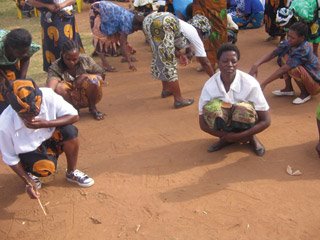
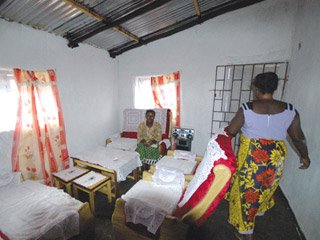
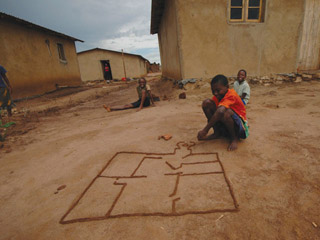
I was ecstatic to find this heartening photo story of the creation, from the ground up, of a replacement village for slums in Lilongwe, the capital city of Malawi. The community was organized through an international super group of federations called Slum Dwellers International.

Selected photo's and their captions:


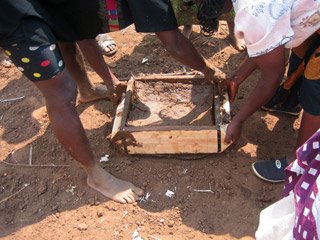
Preparatory meetings


We are all Architects on the ground


We will smile like this for our real houses


Celebrations during the Ground Breaking Ceremony


The first brick


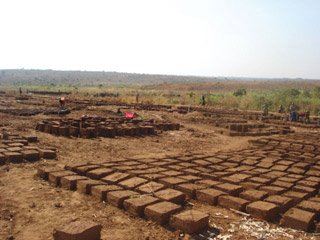
Adobe Everywhere


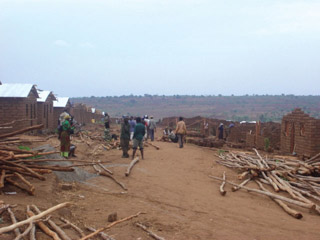
Look at our first house coming up


A hub of employment creation


Women power


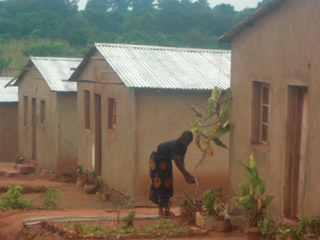
Home Finally


In the lounge


Future architects

See the whole photo story here.

SDI has built a combined total of 80,000 new homes in countries like South Africa, India, Thailand, Cambodia, & the Philippines.

They do so without help from the United Nations, the IMF, or the World Bank. They do so by empowering people. This is urbanism from the people up. It can be done.


More information about Slum Dwellers International:
Slum Dwellers International (SDI) is a loose network of people's organisations from an increasing number of countries in the [Global] South. The network is made up of Federations of community organisations and other grassroots initiatives that are in the process of developing Federations. Linked to this network is a group of professionals who are committed to supporting Federations of the urban poor.

The SDI affiliates in twenty-three countries have come together to give a voice to the poor in an arena of decision-making that has, in recent years, been confined to global organisations that champion neo-liberal theories of development.

As a counterpoint to these agencies, social movements (such as the women's and environmental movements) have emerged. They see themselves as opponents of centralised state power, backed by these global agencies - the United Nations, the International Monetary Fund and the World Bank.

Then there has been a plethora (now diminishing) of organisations in civil society who have mobilised poor individuals, mainly through micro-finance, to help poor people improve their individual standards of living as a means of adapting to the reality created by the alliance of power between multi-laterals and national governments.

SDI affiliates are attempting to pioneer an alternative route to the two that are mentioned above.

Tuesday, May 16

John Dwyer's Clean Hub

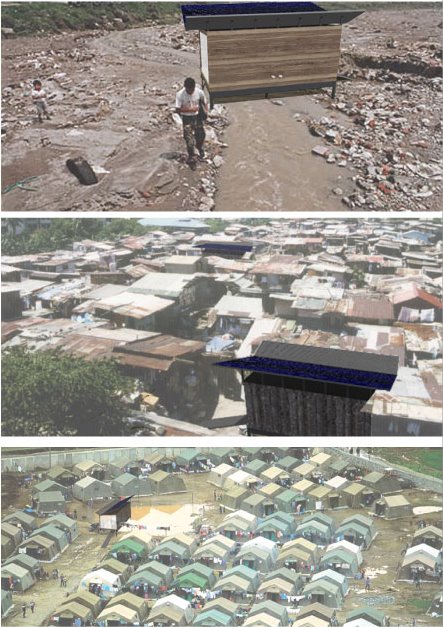
Beating us to the punch, Bryan Finoki recently profiled the Clean Hub on Subtopia. The Clean Hub, designed by AFH|MN member John Dwyer, is a self-contained and self-reliant system designed to bring clean water and sanitation to remote locations, disaster relief efforts, refugee camps, and slums.


Wednesday, April 26

Via Inhabitat: Post-Slum Payatas


Writing for
Inhabitat, Bryan Finoki takes an in-depth look at poverty, slums, dump-site economies and an organization in the Philippines, Gawad Kalinga, that is using disaster relief as a catalyst for changing the socio-economic infastructure that creates such situations in the first place.

Excerpt:
It's good to see organizations that not only deal with the conditions of poverty, but the perceptions (self-perception included) of it, too. Moleto says, "Poverty is not just an absence of money. [...] You just can'’t take away the slums; you also have to take away the slum mentality of the people who live there." And, perhaps the way slums are perceived in general. While this type of poverty can be dehumanizing, I am sure he would agree that for the people who salvage a livelihood for themselves there, the slums are actually a great source of pride and strength, if, at the very minimum, as a means of survival. Indeed, some of the greatest triumphs of human spirit and entrepreneurialism can be found deep within the urban networks of rampant global poverty. Nevertheless, this type of community building just goes to show, if we can continue to bring needed resources together, often times these vibrant and thriving communities will assemble themselves with far greater capacity and ingenuity than perhaps anyone else could provide for them. Isn't that the true source of human pride?


Read the whole post here and more at Bryan's own blog, Subtopia, here.

Friday, March 17

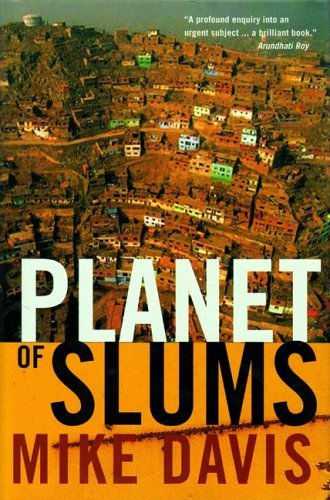
A Planet of Slums

For the first time in human history, the number of people living in urban areas matches the number of people living in rural areas. In fact, after 2020, cities will account for all future world population growth while the number of people living rurally will shrink at a constant rate. The majority of these new "urbanites" will live in cities like Lagos, Mumbai, Mexico City, and Jakarta.

But what's really fascinating is that of all urbanites, world-wide, 3/4ths of them will live in something that can't even really be called a "city" by Western standar
ds. These are the slums, the shantytowns and the favelas... the peripherally urban.

Kibera, Kenya - Africa's largest slum:


This is what humanity looks like, and it's hardly a blip on the radar of what Western culture considers important. Mike Davis, a self-described "Marxist-Environmentalist", explores this complex reality in his new book, Planet of Slums.

Excerpt:

"The cities of the future, rather than being made out of glass and steel as envisioned by earlier generations of urbanists, are instead largely constructed out of crude brick, straw, recycled plastic, cement blocks, and scrap wood... Instead of cities of light soaring toward heaven, much of the twenty-first-century urban world squats in squalor, surrounded by pollution, excrement, and decay."

Amazon.com
Salon.com Review
New Left Review

Monday, March 13

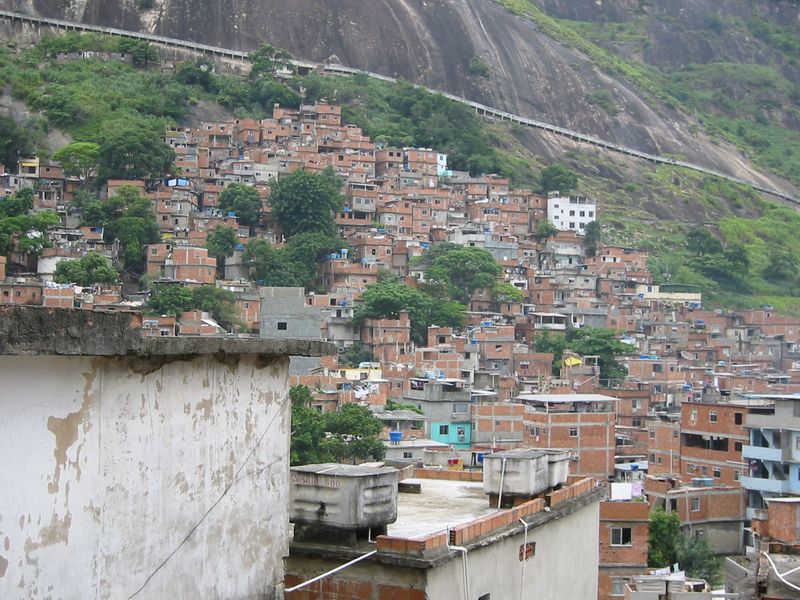
Shantytowns as New Sub/ Urban Ideal

What can the shantytown teach us about urban development? What can it teach us about suburban development? Will we be retrofitting multi-unit apartments into today's McMansions in 50 years? Architect Teddy Cruz is hard at work answering these questions as we speak.

See Rio de Janeiro:

See Tijuana:


Now see Teddy Cruz's "Mi Pueblo" San Ysidro Pilot Village:


NYT article about Teddy Cruz via Archinect. See the Wikipedia entry for "shanty towns" for more on that topic. Robert Neuwirth writes about his four years living in squatter towns in his blog, squattercity. And be sure to check out Bryan Finoki's tour-de-force post, urban syntax: at the border, at his blog, Subtopia: A Field Guide to Military Urbanism.