Showing posts with label future-positive creativity. Show all posts

Saturday, September 22

Talk about mixed use

This is right up there with the Kowloon Walled City in terms of jaw dropping examples of shear density. I have no idea where this video was taken, but it's incredible. File under further evidence of ingenuity in the face of massive over population.


Skip to the end of this one for some beautiful shots from the side of train.

Thursday, August 30

Black Balloons - Making CO2 Real

The Alliance for Climate Protection has a great advert up on their site called Black Balloons - Making CO2 Real (click for video).

The piece does a great job of making something invisible and possibly hard to comprehend very real and accessible.


(Thanks Jeffrey!)

Wednesday, May 30

New Urban Cartography

We have a couple of reports from the urban cartography department today, followed by some personal thoughts about the kind of futures this new urban cartography might be pointing to.

First up is truliaHindsight, which maps the growth of cities over time through a massive online real estate database. The image below (Las Vegas, NV) is indicative of the data overlay you will see over most American cities: a massive housing boom in the 1950's that begins a trend pushing the city edge further and further away from the core. truliaHindsight is just one example of how massive information databases are being used and re-used in new and sometimes very surprising ways. Imagine combining this overlay with 200 years of census data... a thesis project on environmental racism just waiting to happen.


The truliaHindsight website was designed by Stamen Design in San Francisco. One of their more abstract pieces of urban cartography is called Cabstopping.
"The patterns traced by each cab create a living and always-changing map of city life. This map hints at economic, social, and cultural trends that are otherwise invisible."


Their map is part of a bigger project that
works "across the domains of art, design, cultural geography, cartography, information design, sociology, hydrology, marine sciences, and history" for The Museum of Science, Art and Human Perception (a place that I apparently need to visit). Some very cool timelapse videos of these maps can be found here.

Going from abstract and invisible to concrete and very visible, we end with a new project from granddaddies/ mommies of all things searchable. The Google Maps team recently released a new hybrid web application called Street View in which you can navigate through the Google Map as if you were a pedestrian on the street. The people/ hours that must of have gone into this thing are staggering.

It starts out looking like the familiar Google Map, but within the space of a few clicks, you are standing at the intersection of Liberty and Church Streets, looking out over void at the World Trade Center from the comfort of my tiny apartment in St. Paul, MN.


Once in Street View mode, you're free to walk up or down the streets, turn in full 360 degrees, and zoom in for a closer look. Below, I do a 180 and go into full screen mode:


How is this achieved? Let's just say keep an eye out for one of these, coming soon to reflective glass near you.


--- Begin personal thoughts on the topic here ---

What all of this brings to mind is William Gibson's early cyberpunk Sprawl trilogy (Neuromancer, Count Zero and Mona Lisa Overdrive - all excellent novels). This body of fiction, as well as much of Gibson's other work, revolves around his extrapolation that the internet (in its infancy at the time - mid to late 80's) would move beyond information on a screen and become an inhabitable place. In fact, Gibson ended up coining the term "cyberspace" to name his then fictional invention.


Gibson's "cyberspace" literally translated in the film Hackers.

If the Google Street View is any indication of what is to come, we can begin to imagine all manner of information being mapped onto a virtually inhabitable simulacrum of our world. Unlike the cyberspace that Gibson describes in Neuromancer:

"...a graphic representation of data abstracted from banks of every computer in the human system. Unthinkable complexity. Lines of light ranged in the nonspace of the mind, clusters and constellations of data. Like city lights, receding..." (69),
this new cyberspace will be much more familiar to us. It will look and behave in ways we understand - dangerous because the line between real and virtual will be that much more hazed. As the possibilities for exploration, learning, and knowledge building expand - so too will the potential for surveillance, misuse, and abuse.
"Emergent technology is, by its very nature, out of control, and leads to unpredictable outcomes." - William Gibson
Can Google Life really be that far off?

Friday, May 25

Chernobyl Fungi Feed on Radiation


Today we have a science fiction-esque follow up to my previous post about Chernobyl tourism in Prypiat, Ukraine. National Geographic reports that three types of fungus have been discovered to grow larger and faster when fed radiation. Scientists were inspired to further study after observing strange fungus growth on the ruins of the Chernobyl Nuclear Power Plant.

From the paper, published and available at PLoS ONE:

Melanized microorganisms inhabit some remarkably extreme environments including high altitude, Arctic and Antarctic regions. Most dramatically, melanized fungal species colonize the walls of the highly radioactive damaged reactor at Chernobyl and surrounding soils.
The melanin in the fungi apparently gives it a blackish hue. This "pigment may play a role in the fungi similar to that of chlorophyll in plants." The paper points towards further study of melanin and its future potential for energy capture and utilization. In an interview with Ira Flatow on NPR's Science Friday today, lead scientist Ekaterina Dadachova said that this could mean the farming of melanized fungus as a bio-fuel in areas too extreme for conventional farming. Possibilities include underground or even in radiation abundant outer space.

Sadly, I haven't been able to turn up any images of the Chernobyl fungus online. Anybody up for a holiday in Prypiat?

Tuesday, January 9

TOMS Shoes


I just learned about TOMS Shoes over at FMCS and had to post about them here. They are a new company whose sole mission (excuse the pun) is to make the world a more comfortable place. Blake Mycoskie, founder of the company, plans to achieve this goal very simply:

For every shoe you purchase, TOMS Shoes will give a pair of shoes to a child in need.


Check out the video below for more information and (as in my case) some dusty eyed inspiration. (And please let me know if the video doesn't work for you, it's my first time posting one!)


More and more companies and organizations are realizing the power in worldchanging ideas. TOMS Shoes is selling more then just another shoe, they are selling the ability to make a difference, the ability to make your voice as a consumer heard, the ability to vote with your dollar.

Ladies and Gentlemen, there is a new economy forming right in front of our eyes, an economy based on values and reputation.

Friday, December 22

Holiday Like You Give A Damn


[image]

Whether you celebrate Christmas, Hanukkah, Kwanzaa, or just the fact that you get a couple days off from work, Blog Like You Give a Damn and the folks from Architecture for Humanity | Minnesota would like to wish everybody out there a Happy Holiday. I hope you enjoy this brief seasonal miscellany:

Changing the Present
Americans spend 250 billion dollars every year just buying each other gifts. Imagine what would happen if we could capture just a portion of that and direct it into worldchanging organizations and charities.

OK, now stop imagining, and check out ChangingThePresent.org.

ChangingThePresent envisions a new way to show someone you care. Rather then buy dad a new electric shaver, why not clear 10 square meters of a minefield for him ($30) or help feed an HIV patient for 6 months for him ($60). There are several hundred charities to choose from and ChangingThePresent has put them all at your fingertips, so matter who you are gifting, you will find a cause you can both be proud of.

[Via WorldChanging]

2 New Magazines That Give a Damn (Great Gift Ideas)
GOOD Magazine (6 issues) - $20 (The full amount of your subscription fee goes to the charitable organization of your choice.)


Mission: "While so much of today's media is taking up our space, dumbing us down, and impeding our productivity, GOOD exists to add value. Through a print magazine, feature and documentary films, original multimedia content and local events, GOOD is providing a platform for the ideas, people, and businesses that are driving change in the world."

NEED Magazine (4 issues) - $27.


Mission: "NEED magazine is an artistic hope-filled publication focusing on life changing humanitarian efforts at home and abroad. NEED magazine reveals the remarkable stories of people involved throughout the entire humanitarian aid process: survivors, workers, funders, and heroes. NEED magazine's dynamic visual narrative is not only compelling, but also drives awareness, involvement, personal connection, and contributions."
[Thanks for the heads up Maureen!]

Ikea Gives the Gift of Non-Gasoline Dependent Transportation
Ikea UK has given all 9,000 of it's employees a new bicycle for Christmas, as well as a 15% subsidy on public transportation. "The bike is a fun present but there is a serious message. We all have a responsibility to do what we can to protect the environment," says Ikea's UK manager, Peter Hogsted.

In addition to charging for the use of plastic bags and giving customers the option of planting a tree for one extra dollar when they check out, Ikea seems to be one international corporation that "gets it." More power to them!

Happy Holidays! See you in the New Year!

Tuesday, May 16

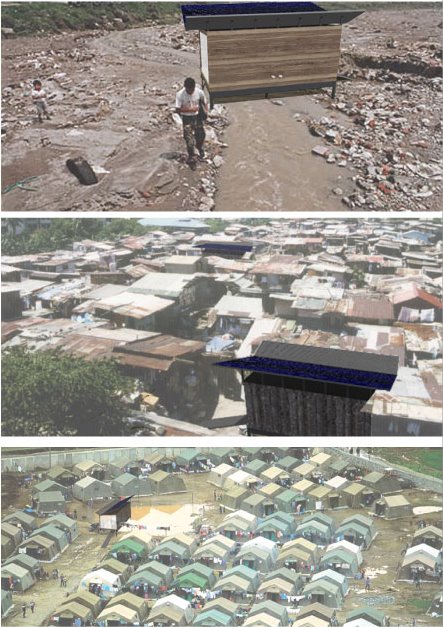
John Dwyer's Clean Hub

Beating us to the punch, Bryan Finoki recently profiled the Clean Hub on Subtopia. The Clean Hub, designed by AFH|MN member John Dwyer, is a self-contained and self-reliant system designed to bring clean water and sanitation to remote locations, disaster relief efforts, refugee camps, and slums.


Saturday, May 6

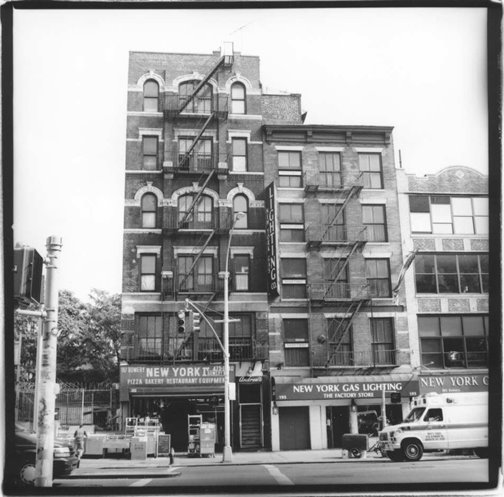
The Flophouse: Making an Old Idea New Again


[image: Harvey Wang]

Last Sunday the New York Times put out an article by Janny Scott titled Making a Flophouse a Home, And a Decent One at That. The article is all about the Andrews House, one of the last remaining Flophouses in New York City. In 1997, Common Ground interviewed aproximately 100 homeless people, all of whom shared a disinterest in the type of housing (with built in social services and support programs) that CG was currently offering.

"Many said they wanted something small, private, safe, cheap; they wanted just enough space for themselves and their belongings. They had a little money, though not enough for an apartment. They could pay. And they wanted anonymity."

CG realized that they didn't need a new housing type, the results of the survey described a housing type that already existed in the form of the Flophouse. As usual, Wikipedia offers us a great definition of the word:

Flophouse: ... A place that offers very cheap lodging, generally by providing only minimal services. Occupants of flophouses generally share bathroom facilities and reside in very cramped quarters. The people who make use of these places are often transients, although some people will stay in flophouses for long periods of time, —years or decades. Some people who live in flophouses may be just a step above homelessness. In the late 20th century, typical cost might be about US$6 per night. A typical flophouse might advertise its services with a sign such as "Hotel for Men; Transients Welcome".

Quarters in flophouses are very small, and may resemble office cubicles more than a regular room in a hotel or apartment building. A cubicle might only have wire mesh for a ceiling.


The last sentence there is of particular interest. CG was faced with the challenge of redesigning the Andrews House, a double loaded corridor style building only 17 feet wide, into something that provided viable spaces to live.


[aproximate floor plan of the Andrews House]

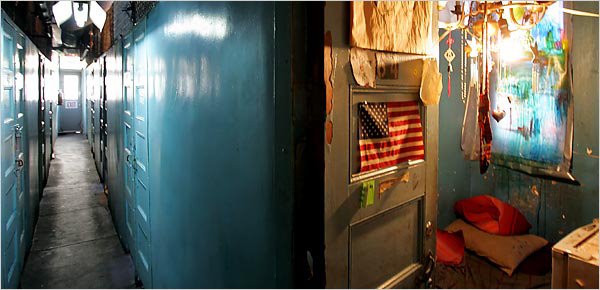
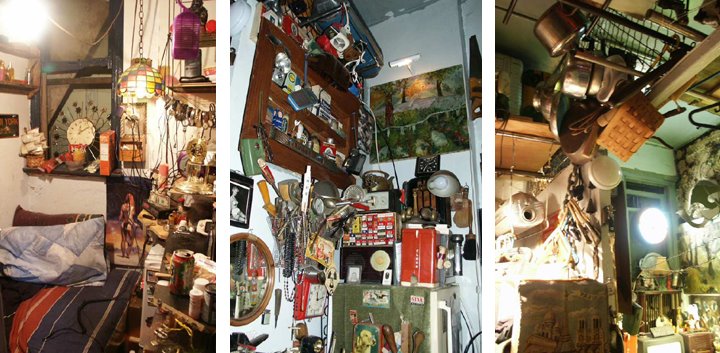
As it existed, The Andrews House was only a “home” in name. What vitality and integrity the structure retained came only from it's residents. The living cubicles, cramped and lacking sunlight, became a place for the men living there to keep and proudly display their worldly possessions. It was a place to take respite from the outside world, even if just by watching TV on the small bed, but as it was, the building was in desperate need of a makeover.


[image: inside the Andrews House, James Estrin]


[image: a corridor splits the 17' wide building]


[image: inside the cubicles, years of possessions]

In admirable fashion, Common Ground opened up this monumental challenge to the design community with a competition. The winning entries all met the challenge to varying degrees of success and the Andrews House is currently under construction, set to open in the spring of 2007. You can see from the images below that many of the winning designs addressed at least two of the major design concerns: how to bring light into the cubicles and how to maximize the space efficiency of the tight quarters.


[image: "Kit of Parts" by LifeForm]


[image: "The Ordering of Things" by Katherine Chang & Aaron Gabriel]


[image: "Soft House" by Forsythe + MacAllen Design]


[image: "Cacoon" by Daniela Fabricius]

Further Information:
NYT video with a more in depth look into Common Ground and The Andrews House.
Flophouse: Life on the Bowery by David Isay & Stacey Abramson, with Photographs by Harvey Wang.

Wednesday, April 26

Via Inhabitat: Post-Slum Payatas


Writing for
Inhabitat, Bryan Finoki takes an in-depth look at poverty, slums, dump-site economies and an organization in the Philippines, Gawad Kalinga, that is using disaster relief as a catalyst for changing the socio-economic infastructure that creates such situations in the first place.

Excerpt:
It's good to see organizations that not only deal with the conditions of poverty, but the perceptions (self-perception included) of it, too. Moleto says, "Poverty is not just an absence of money. [...] You just can'’t take away the slums; you also have to take away the slum mentality of the people who live there." And, perhaps the way slums are perceived in general. While this type of poverty can be dehumanizing, I am sure he would agree that for the people who salvage a livelihood for themselves there, the slums are actually a great source of pride and strength, if, at the very minimum, as a means of survival. Indeed, some of the greatest triumphs of human spirit and entrepreneurialism can be found deep within the urban networks of rampant global poverty. Nevertheless, this type of community building just goes to show, if we can continue to bring needed resources together, often times these vibrant and thriving communities will assemble themselves with far greater capacity and ingenuity than perhaps anyone else could provide for them. Isn't that the true source of human pride?


Read the whole post here and more at Bryan's own blog, Subtopia, here.

Tuesday, March 21

Structures For Inclusion 6

The Structures For Inclusion conference, held in San Francisco, runs from Friday, March 24th to Sunday, March 26th. Architecture For Humanity's co-founder Kate Stohr will be a moderating a panel entitled "Designers Roles in Disaster Preparedness & Relief". AFH|MN's own Maureen is excited to be able to attend the conference and we are excited to hear about it when she gets back. Expect more from her later.

"From its inception in 2000, the dual mission of SFI has consistently been 1) to showcase design efforts that reach out to and serve a diverse clientele, and 2) to provide information on alternative career paths available to students and young designers."

For more information: Structures for Inclusion 6

While looking into this conference I found out that it is put on, in part, by the Design Corps. The Design Corps works in conjunction with AmeriCorps, linking interested and skilled volunteers with groups around the US in need of design services.

They offer 1 and 2 year Fellowships. Past and ongoi
ng projects include a farmworker/ migrant housing program, self-help housing, and other various community planning/ building projects. They have ongoing projects in Alabama, Florida, New Orleans, North Carolina, and Virginia, as well as a summer design/ build studio for students.


In my hectic last months of school I entertained the idea of working for AmeriCorps but had trouble finding a program that was design related. How I missed such a great resource I have no idea, but I'm now beginning to entertain similar thoughts...

Two other groups have a hand in the SFI conference as well: Public Architecture, and Urban Ecology. A more in depth look into these and other related organizations to come.